
Read Time Estimator
A “5 min read” label helps readers decide to start — and a speaking time tells you whether your talk fits its slot. Paste your text to get reading and speaking time based on published research on reading speed, plus word counts and readability scores, all calculated privately in your browser.
- Free to use
- No sign-up
- Runs in your browser
Read time estimator
Content Timing Template Pack
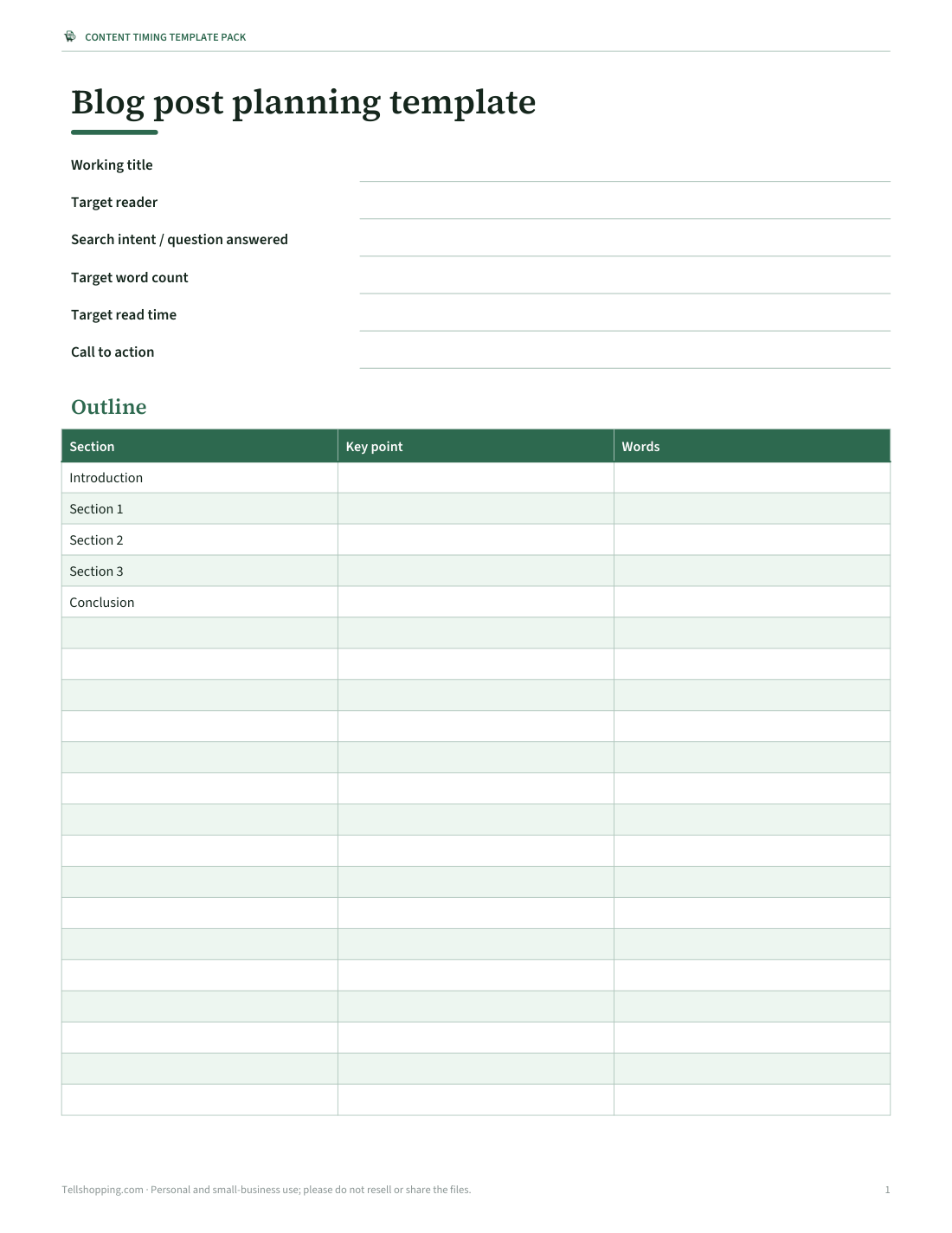
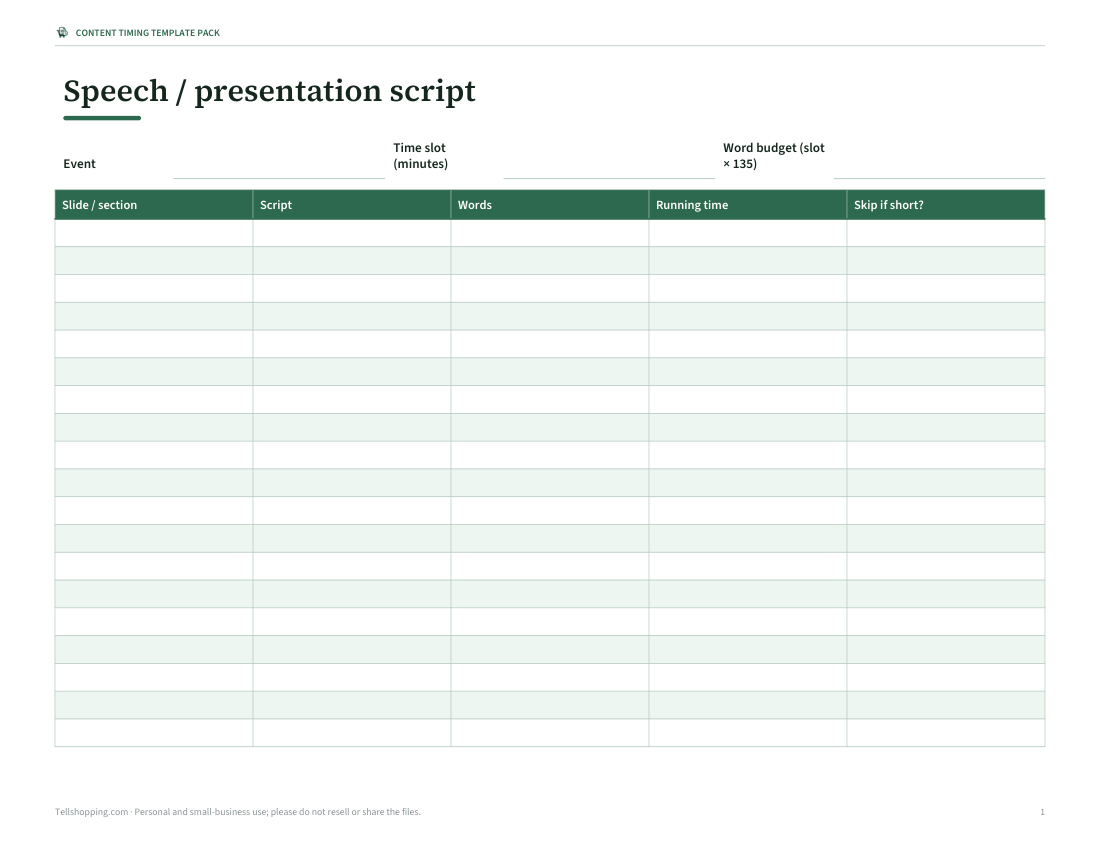
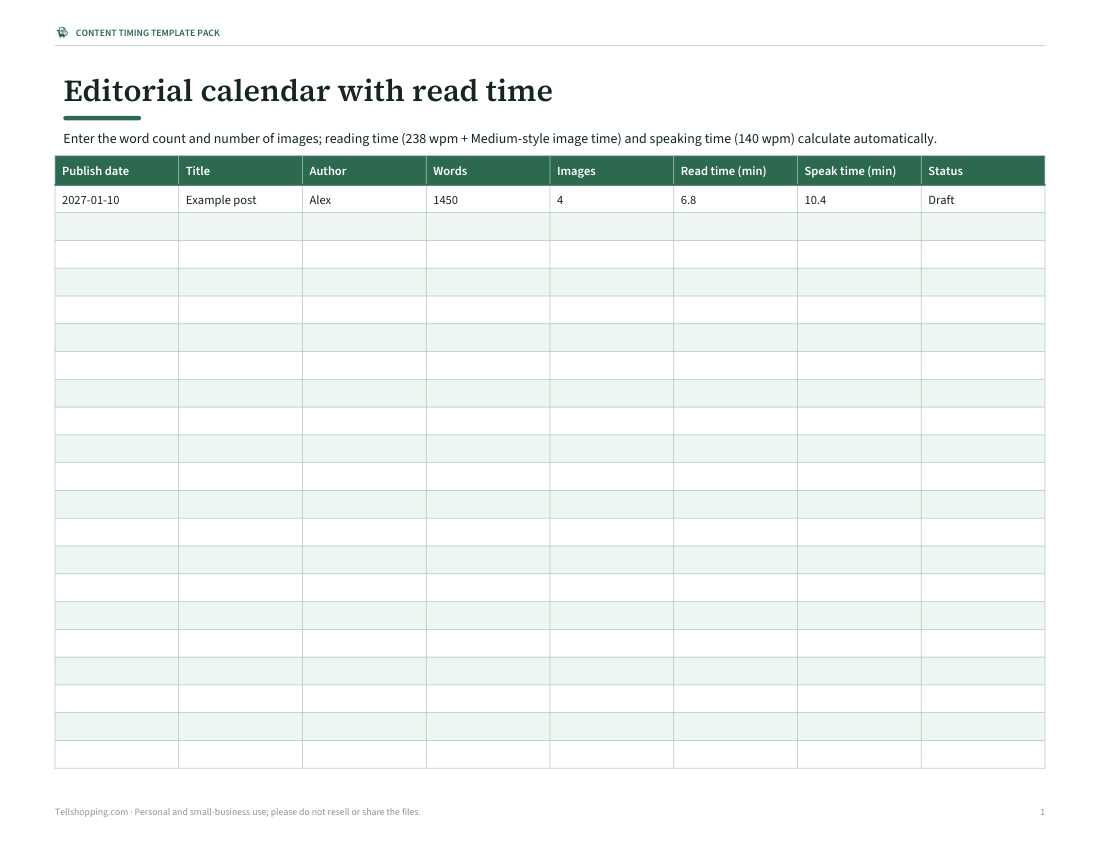
Blog post planning template, speech script template with timing column, editorial calendar spreadsheet that converts word counts to reading and speaking time, presentation timing worksheet and a readability checklist.
- Blog post template (DOCX/PDF)
- Speech script template (DOCX/PDF)
- Editorial calendar (XLSX)
- Timing worksheet (PDF/DOCX/XLSX)
- Readability checklist (PDF/DOCX)
Formats: DOCX, PDF, XLSX. Instant download after payment (link valid 72 hours, up to 5 downloads). AI-assisted: the templates were drafted with AI help and reviewed and laid out before publishing.
$5.00 USD, one-time 5 files · about $1.00 each
- Instant download
- 7-day refund
- Secure checkout by Stripe
7-day money-back guarantee. Full refund within 7 days of purchase, even after you download.
Free sample: Blog Post Planning Template (PDF, 55 KB)
Full refund within 7 days — see the refund policy and license.
Free printables
Single sheets you can print right now, no sign-up. The full pack adds every sheet in one download plus the editable files.
 Printable Blog Post Template
 Speech Script Time Estimator
 Printable Editorial Calendar Read Time Estimator
 Printable Presentation Timing Worksheet
 Printable Readability Checklist
How the estimate is calculated
Reading time is the word count divided by a reading speed. A 2019 meta-analysis of reading-rate studies by Marc Brysbaert estimated that adults read English non-fiction silently at about 238 words per minute on average and fiction at about 260 — the defaults used here. Medium’s published method uses 265 words per minute and adds time for images: 12 seconds for the first image, one second less for each following image, and 3 seconds for each image after the tenth. The estimator includes that image rule when you enter a number of images.
Reading and speaking speeds
| Activity | Typical speed | 1,000 words takes |
|---|---|---|
| Silent reading, non-fiction | 238 wpm | 4.2 min |
| Silent reading, fiction | 260 wpm | 3.8 min |
| Careful / technical reading | about 200 wpm | 5.0 min |
| Presentations and speeches | about 130–150 wpm | about 6.7–7.7 min |
| Audiobook narration | about 150–160 wpm | about 6.3–6.7 min |
Individual speeds vary widely with the reader, the language, the difficulty of the text and the purpose of reading.
Worked example
A blog post of 1,450 words with four images: at 238 wpm the text takes about 6 minutes 6 seconds, and the images add 12 + 11 + 10 + 9 = 42 seconds, so the total is about 6 minutes 48 seconds — a “7 min read”. Read aloud as a podcast at 140 wpm, the same text would take about 10 minutes 21 seconds.
Readability scores
| Flesch reading ease | Description | Roughly suitable for |
|---|---|---|
| 90–100 | Very easy | Age 11 and up |
| 70–89 | Easy / plain English | Most adults, ages 12–15 |
| 60–69 | Standard | General audiences |
| 50–59 | Fairly difficult | Upper secondary |
| 30–49 | Difficult | College |
| 0–29 | Very difficult | Specialist / academic |
Flesch reading ease = 206.835 − 1.015 × (words per sentence) − 84.6 × (syllables per word). The Flesch–Kincaid grade level turns the same inputs into an approximate US school grade. Syllables are counted with a heuristic, so scores are estimates; use them to compare drafts rather than as exact measures.
Timing a speech or presentation
- Multiply your slot in minutes by about 130–140 to get a word budget: a 5-minute talk is roughly 650–700 words.
- Leave 10–20% of the time for pauses, slides changes and audience reaction.
- Rehearse aloud with a timer — nerves often speed people up.
- Mark “skip if short on time” sections in your script.
What slows reading down
| Factor | Effect on reading time |
|---|---|
| Technical vocabulary | Readers slow down or reread unfamiliar terms |
| Long sentences | More to hold in memory; comprehension drops |
| Numbers and tables | Often read more slowly, or skimmed |
| Code blocks | Usually skimmed or studied — hard to predict |
| Reading on a phone | Smaller screens can mean more scrolling and re-reading |
| Second-language readers | Can read considerably more slowly |
For technical documentation or academic writing, choose the careful 200 wpm setting; for light blog posts and fiction, 238–260 wpm is reasonable.
Word counts for common formats
| Format | Typical length | Reading time at 238 wpm |
|---|---|---|
| Social media caption | 50–150 words | under 1 min |
| News article | 500–800 words | about 2–3 min |
| Blog post | 1,000–2,000 words | about 4–8 min |
| Long-form feature | 3,000–5,000 words | about 13–21 min |
| Short story | 1,000–7,500 words | about 4–32 min |
These are common ranges rather than rules; write as long as the topic needs and no longer.
Why show a reading time?
Reading-time labels set expectations, and many publishers display them next to headlines. They are most useful when they are honest: round to the nearest minute, and don’t count navigation, comments or code blocks that readers skim. The snippet above includes the schema.org timeRequired property in ISO 8601 duration format (PT7M means seven minutes) and wordCount for structured data.
Using read time in your workflow
- Set a target read time when you plan a piece — for example “5–7 minutes” — and convert it to a word budget.
- Check the estimate after the first draft; if it runs long, cut repetition before cutting substance.
- Check readability at the same time: long sentences often explain an over-long read time.
- Add the label and snippet when you publish, rounding to the nearest minute.
- For talks, rehearse with a timer and update your speaking pace to match your own voice.
Keeping word counts and read times together in an editorial calendar makes it easy to balance quick reads with longer features across a month.
What’s in the template pack
- Blog post planning template with word-count and read-time targets
- Speech and presentation script template with a timing column
- Editorial calendar spreadsheet that converts word counts to reading and speaking time
- Presentation timing worksheet
- Readability self-edit checklist
The pack is a one-time download; the estimator itself is free.
Privacy
Your text is analysed in your browser and never uploaded.
Frequently asked questions
How many words per minute do adults read?
Around 238 wpm for non-fiction and 260 for fiction on average, according to a 2019 meta-analysis.
How long is a 1,000-word article?
About 4 minutes of silent reading, or about 7 minutes read aloud.
How many words is a 5-minute speech?
Roughly 650–750 words at a comfortable pace.
How does Medium calculate read time?
It uses 265 wpm plus time for images, starting at 12 seconds for the first image.
What is a good Flesch reading ease score?
60–70 suits general audiences; higher is easier.
Is my text uploaded?
No. Everything runs in your browser.
Should I count headings and captions?
Yes for reading time — readers see them — but you can leave out navigation and comments.